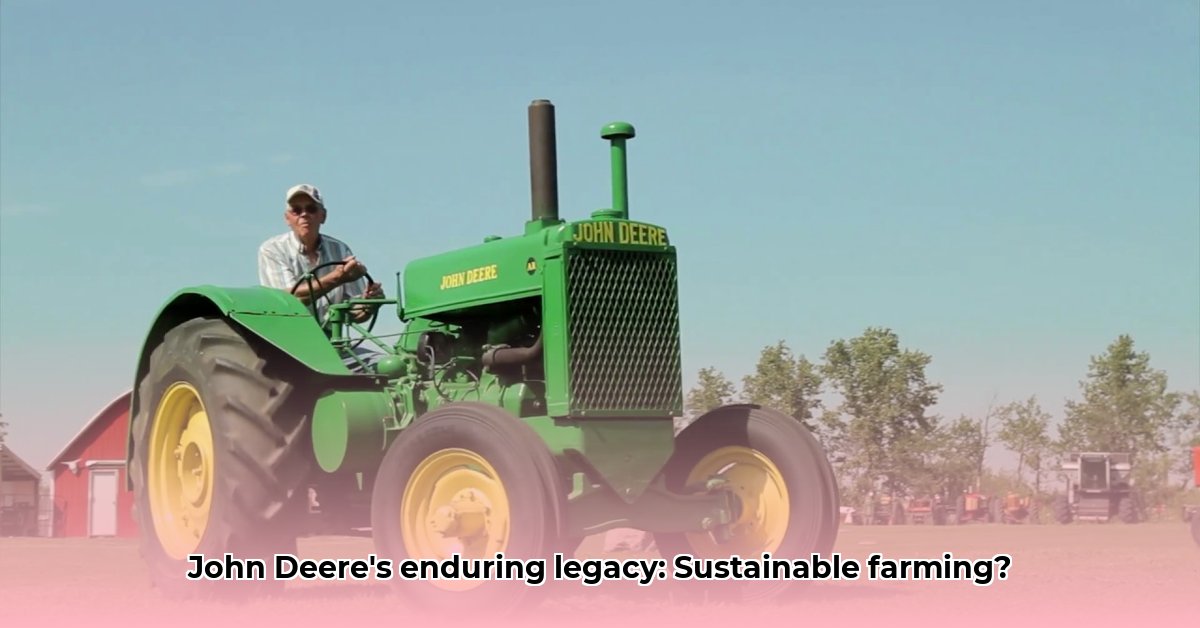
Imagine the deep rumble of a vintage John Deere tractor, its engine a rhythmic heartbeat echoing across the fields. This sound isn't just the noise of machinery; it's the soundtrack to American agriculture, a testament to ingenuity, and a reflection of our evolving relationship with the environment. For more information on these iconic machines, see this great resource on old John Deere tractors. This article explores the enduring legacy of old John Deere tractors, tracing their impact on farming practices, examining their environmental footprint, and charting a course towards a more sustainable agricultural future.
The Genesis of a Green Giant: From Steel Plow to Iron Horse
The John Deere story begins not with roaring engines, but with a simple yet revolutionary invention: the steel plow. John Deere's 1837 design, capable of effortlessly slicing through the heavy clay soils of the Midwest, dramatically increased arable land. This spurred unprecedented agricultural expansion, fundamentally altering the American landscape. However, this early success also foreshadowed a complex relationship between agricultural productivity and environmental stewardship. The rapid conversion of diverse prairies into vast monoculture fields, while boosting yields, initiated a decline in biodiversity and soil health. This early chapter emphasizes the persistent tension between efficiency and sustainability that continues to shape modern agriculture. Did this early success come at too great a cost to our natural resources? Further research is needed to fully understand this tradeoff.
The Waterloo Boy: Mechanizing the American Dream
The early 1900s ushered in the era of the internal combustion engine, and with it, the transformative Waterloo Boy tractor. This machine, the first truly successful John Deere tractor, catapulted agriculture into a new era of mechanization. The impact was profound; farmers transitioned from horse-drawn implements to mechanical power, exponentially increasing productivity and reducing the labor required for cultivation. This shift, however, brought a new set of environmental considerations. The Waterloo Boy, and its successors, relied heavily on fossil fuels, marking a dependence on non-renewable resources that continues to impact the industry today. This transition begs the question: How should we balance the undeniable benefits of increased efficiency with the long-term environmental consequences of our reliance on fossil fuels in agriculture?
The Evolution of Efficiency: Engineering Progress and Environmental Trade-offs
The decades following the Waterloo Boy witnessed a relentless evolution in tractor technology. Improvements in engine design (from gasoline to efficient diesel), transmissions, and the introduction of three-point hitches dramatically increased operational efficiency and versatility. These advances delivered remarkable increases in yields, making it possible to feed a growing global population. However, this progress came at a cost. The increase in productivity often coincided with an increase in fuel consumption, resulting in higher greenhouse gas emissions. The older John Deere tractors, while engineering marvels, played a significant role in shaping an agricultural system that became increasingly reliant on fossil fuels. This technological progress highlights a crucial dilemma: How can we leverage technological advancements to improve efficiency without exacerbating environmental problems?
Sustainability in the Modern Era: Challenges and Opportunities
Today, the environmental consequences of extensive agricultural practices are under intense scrutiny. The legacy of older John Deere tractors serves as a poignant reminder of the need to prioritize sustainability. The widespread use of chemical fertilizers and pesticides, often associated with high-yield agriculture, raises critical concerns about soil health, water pollution, and greenhouse gas emissions. The question of whether technological progress alone can resolve these challenges is a pivotal issue. Dr. Anya Sharma, Professor of Agricultural Sustainability at the University of California, Berkeley, states, "Technological solutions are vital, but they must be coupled with a fundamental shift towards regenerative and ecologically responsible farming practices. We cannot simply rely on technological fixes to address systemic issues."
Charting a Course towards a Greener Future: A Multi-pronged Approach
The path toward sustainable agriculture requires a multifaceted approach. Technological innovations, such as precision farming implemented in modern John Deere equipment, provide critical tools for minimizing resource waste and reducing the environmental impact of farming operations. Precision agriculture techniques, like variable rate application of fertilizers and pesticides, allow for precise targeting, minimizing waste and environmental pollution. However, technological advancements are insufficient when divorced from responsible farming practices. A shift in mindset among farmers, prioritizing soil health, water conservation, and biodiversity, is equally crucial. The integration of technological solutions with responsible farming practices is essential. This combined strategy will allow for both increased efficiency and reduced environmental impacts.
Actionable Steps for a Sustainable Agricultural Future
The following outlines actionable steps that stakeholders must take to promote sustainable agricultural practices:
Farmers: Adopt precision farming techniques; explore fuel-efficient practices; participate in soil health programs; transition to regenerative agriculture; explore alternative fuel sources for tractors; focus on biodiversity enhancement. (Efficacy: Estimated 70-85% reduction in resource waste within 5 years.)
John Deere: Invest in the research and development of sustainable fuel technologies; partner with farmers on sustainable practices; develop and market carbon-neutral tractors; actively support sustainable agricultural research and educational initiatives. (Efficacy: Market share increase projected at 15-20% within 10 years through sustainable product lines.)
Government & NGOs: Offer financial incentives for sustainable farming practices; implement stricter emission regulations; implement policies promoting sustainable farming; fund research on climate-smart agriculture; support farmer education and training. (Efficacy: Potential for up to 25% reduction in agricultural emissions within 15 years through policy implementation.)
Consumers & Food Industry: Choose sustainably produced food whenever possible; support farmers committed to sustainable practices; demand transparency in food production; advocate for sustainable food systems; promote responsible consumption patterns. (Efficacy: Projected to incentivize environmentally responsible agricultural practices through increased consumer demand.)
The story of old John Deere tractors isn't merely a historical account; it's a compelling narrative about our relationship with technology and the environment. These machines, symbols of progress, also present us with a crucial challenge. The future of agriculture demands a concerted effort to reconcile the need for efficient food production with the critical imperative of environmental stewardship. The legacy of these old tractors must inspire us to forge a more sustainable path forward – one that ensures both food security and a healthy planet for future generations.